Current list of U.S. eLearning Patents and Patent Applications

http://www.immagic.com/eLibrary/ARCHIVES/GENERAL/IMM/I070524P.pdf

I believe, though could be mistaken, that this valuable list of current US e-learning patents was created by Jim Farmer at im+m.

This next comment goes in the “Scott complaining about something that is free” bin, but Jim, is there any way you could maintain this (if that is what you are doing in) in something like DabbleDB or a GoogleDoc spreadsheet? Something that automatically produces an RSS feed (and that you could give permission to others to add to, so as to not have to shoulder the burden alone).

Efforts like this that keep the community appraised are immensely valueable. And I don’t want to sound ungrateful, but much like the case with the Ed Tech conference listings I documented a while back, in this day and age we need to be looking at web-based formats and tools by default, ones that produce RSS and allow collaborative editing. There is simply too much too kepp track of to do otherwise, and it is only in spreading the load that we can hope to keep up. – SWL

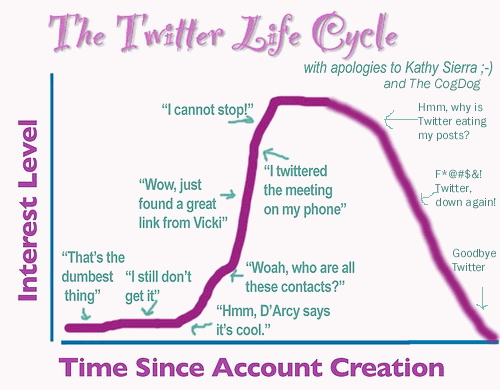
My Twitter Cycle

With apologies to CogDog,

It’s been fun, but for me, my experiment with Twitter is done. I tried briefly to encourage a mass migration of Twitter pals to Jaiku, but didn’t have the social mojo to accomplish it, and in truth, it didn’t appeal to me that much – too “busy,” not as simple and clean as Twitter, and as everyone pointed out, relatively empty of users.

It’s too bad, the experiment was fun, I really enjoyed the daily interaction with old friends like CogDog, D’Arcy and Brian and making new ones with Bryan, Jim, Gardner and others, but at the end of the day I have no affection for flaky apps that leave me feeling like I’m the one with the problem instead of just plain breaking (which at least you know was the apps fault). So goodbye Twitter, it’s been nice to know yah. And hopefully this won’t render me persona non grata with the Twitterati. – SWL

BibliOdyssey

http://bibliodyssey.blogspot.com/

Total non-sequitar (how is that any different than usual, Scott) but BibliOdyssey, a trove of “Visual Materia Obscura” and Eclectic Bookart, took me back to my undergraduate days.

As part of a Milton class my professor took us to Western’s rare book room to see some illustrated editions there. For the next 3 years it became my secret study haven, both because it was amazingly quiet (nobody else seemed to know about it), it had these great big oak tables, and contained these freaky books. I would ask the librarian to bring various works with weird and fanciful illustrations and open it on one of the pages, then work on my own stuff, looking at the illustration as a break. They either never caught on or else just tolerated me, but I had a perfect study space and loads of mind bending fun too boot. – SWL

Study Stickies – Some Thoughts on Effective “Web 2.0” Annotation Systems

http://studystickies.com/

Amir Michail, the developer of a new service called Study Stickies, wrote an email asking me to look at and comment on his new service. Study Stickies is a ‘social’ note taking service for students. It allows them to enter info about textbooks, vodcasts, podcasts, PDFs and URLs and add study notes, linked to specific sections of these resources, which can also be tagged for finding and re-finding by others. It also seems to handle mathematical notations with ease.

There’s nothing fundamentally wrong with the idea; indeed it reminded me of the “conversations” I’ve had with previous owners of second hand textbooks, evoked by their marginalia.

My issue, and what feels like it may be a challenge to adoption for a service like this, is around “where” the annotation takes place, “how” it occurs, both of which tie into the “why.” For instance, to annotate a textbook one needs to first enter in it’s ISBN number. But we already have a few places where students can find their textbooks online, either their library catalogues or amazon.com. A “web 2.0” approach, that took seriously the value in leveraging existing services, would either offer a way (say a bookmarklet) for users to cite the thing they are commenting on *in context*, or, say like LibraryThing, at least tie into the APIs of Google and library catalogues everywhere to offer a query service. This is the kind of thing I often hear dismissed as an “implementation detail” (god how I hate that phrase) but it’s one of those small things that has lead to the uptake of countless web 2.0 sites that ‘get it’ and which is not done in countless web 1.0 sites that don’t. This is the “how” I refer to above.

The second piece is the “where” – the annotation systems that really excite me, for this is in essence what Study Stickies is, are the ones, like Trailfire, that reveal the annotations in context, while I am looking at the very thing that is annotated, especially for the “re-finders.” Think back to my above comment about marginalia in second hand books; this is how the experience should work like, instead of like finding someone’s notebook from last year’s class and then piece by piece connecting it back to the pieces of content on which it is commenting.

And both of these minor “implementation details” for me tie into the “why” people do (or do not) use services like this. If it allows me to easily add a note, while I am studying materials online, then I am motivated to use it for my own uses, and the network benefits from my personally motivated actions. People often point to “tags” as being the fundamental reason for del.icio.us success, but I would argue that the bookmarklets and toolbars that allow you to easily add to it were equally part of its success. And if, while looking at a resource, I am told that there are already notes from others which may be of relevance to me, I become motivated, again for selfish reasons, to take advantage of the network resource and increase its value.

Maybe these issues are not fatal flaws for Study Stickies. I can see ways in which they can address these as they move forward, and clearly it is a very young system. But I’d suggest that small “implementation details” like this are actually some of the things that lead to explosive growth for many of these new systems.

Yet there is an important thing Study Stickies has which the more “internet-wide” systems don’t, and that’s context. When you find an annotation in Study Stickies, by definition it’s a “study note,” something that a user in a likely not-too-dissimilar context to your own made, which offers a good chance of enhancing its value to you. In an internet-wide system like Trailfire, who knows who made the mark and whether it has any value to you. Sure, sometimes they’ll bear serendipity, but as many times, not, and worse, things that by right and by law we are often required to shield out. Or else, what is now more common with the current generation of social software systems, you can form a group, but its yet another ad hoc group built anew with each app that comes along.

—snip—

I have been trying for almost a week to finish this post. I wanted to talk about the critical need for not just open identification but, as importantly, open authorization. How their absence has allowed things like the Blackboard patent to flourish (read it, what do you think it’s about). And how these will provide the impetus for the next huge round of innovation, truely, social computing. But I couldn’t figure out how to do it in the time I have. So there. Rather than let this post go totally stale, click ‘Publish’ and be done with it. – SWL

Death and…

Ok, I expect this is one to be put in the “see what you get when you leave it to the last minute” file, but the internet gods are conspiring against me (and I expect hundreds of others) today as we try to get our taxes in on time.

As if it wasn’t bad enough that Revenue Canada, in their inimitable and unassailable way, lied on their web pages when they said that operators were available on the weekend to answer questions (they are not, at all, for individual run businesses, and if they are for private individuals I’d love to hear from someone who got through, it rang busy for 2 days straight for me).

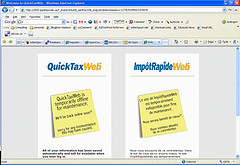
No, that clearly wasn’t enough hassle. Now Quicktax, my former online tax preparation service of choice, goes down on April 29th, the day before taxes are due in Canada. Uggghhh!!!! I can just see the conversation now – “whaddya mean I was supposed to be keeping track of disk space; that’s your job!”

What was that about the only other certain thing in life besides taxes – oh yeah, the intransigence of IT departments everywhere 😉

Tagging and Metadata for Social Information Organization Workshop

http://www2007.redlog.net/

Last week during the “digital content strategy” roundtable I sat on at UBC, one of the things I urged was for the librarians there to take tagging seriously (to which I actually got a partially affirmative response). I am not sure if this is a case of “be careful what you wish for” but not long after urging this I see notice of this upcoming workshop, titled “Tagging and Metadata for Social Information Organization” being held at my old stomping ground in Banff. Assuming for a second that it can be studied without having all the dynamism that makes it work sucked out of it, here’s hoping I don’t have to make pleas like that for too many more years. – SWL

Democracy – Open Source Vodcast Player

http://www.getdemocracy.com/

The other night at dinner, I was reflecting on the somewhat disappointing results to date of my family’s experiment to create a PC-based home media centre upstairs in our living room. So far we’ve mostly been plagued by hardware problems, network connectivity problems, TV resolution problems, yada yada. The whole goal of the exercise had been to give my family internet access upstairs in the house without having to have an additional computer station setup, and in so doing introduce them to the joys of user generated content. But since the experiment started after Christmas it has mostly been Dad, me, diddling around with cables and replacement parts.

This started to change recently – now my wife has a queue of requests for, ahem, Bittorrent, and for my birthday on Monday I entertained the crowd with some amusing clips from Youtube. But we really turned the corner last night with Democracy, an open source vodcast player by the brilliant folks at the Participatory Culture Foundation.

In brief, Democracy does for vodcasts what GReader does for blogs – makes it dead simple to subscribe and consume RSS fed video clips, and downloads them in the background so that if you set up the feeds correctly and leave it running, you can have a TV-like experience (except without all the crappy channels and the advertising.) Which I did last night, watching a bunch of episodes from the Jetset show (wow, do I feel old) MediaBerkman and Awakened Voice Learning Centre, who produce a series of screencasts on using various social software tools.

Yeah, I know, nothing that revolutionary here; the Mac guys are all scratching their heads and wondering “iTunes?” I hate iTunes, refuse to use it. So for me, this is the first time a really usable interface for finding and consuming vodcasts on a consumer device has presented itself to me. It’s free. It’s cross platform. It allows you to search Google video, Youtube, Blip.tv and revver directly from the interface, and, if you swing that way, will handle your torrents for you as well. Looks like the dream of tuning out the mass media without totally forsaking the upstairs TV may not be as dead as it first seemed. – SWL

What I learned at Dinner

Last night I had dinner at Brian and Keira’s house with David Wiley and Brandon Muramatsu. It’s hard to express what an honour this was for me, not just to hang out with some of my truly favourite people, but to be able to quiz David and Brandon for a few hours even after David’s marathon travels. You have to understand – I have never been in doubt about the social nature of learning, as I’ve long recognized that personally I learn best through conversation and inquiry. Yet I’ve always been a “difficult student,” sometimes my honest effort to comprehend through questioning is taken, unintentionally, as criticism, and so it’s even more amazing to be able to engage in such questioning dialogue with people whose wisdom and compassion leave them not just unfazed, but able to offer me gifts I’m needing, especially the ones I didn’t know I needed. I think that’s what’s also known as a “teacher.”

The list of things I learned over the evening is too long to really enumerate, but there is one piece I will share with you, and if I get it wrong it’s entirely my fault. Many of us are trying to innovate social software, open education and the like inside of institutions that aren’t doing either at all currently. And it is attractive to imagine that there are “baby steps” we can take “inside” the institutional silos to get them used to the ideas before proceeding to more full fledged implementations. But the real danger with this approach is that in taking these “baby steps,” we miss out on the power of the “network effects” that are in fact integral to the positive feedback loops of succesful social software. And in so doing, we end up potentially discrediting technologies and approaches that are absoolutely valid because the implementation details DO matter. Which is not to say we should start off small, but that we must start off in a way that right from the beginning we enable to power of the network effect to take hold. If you want to hear what I think is much the same message stated much better, please go listen to David’s talk yesterday at BCNet. Openness is a necessary condition for reuse. It took me a while, but I do get it now. Thanks for your patience. – SWL

Mea Culpa – I’m a Twit

And by that I mean more so than you usually think. 

Brian found it kind of rich that not 2 days after publicly dissing twitter on his blog, an email showed up in his inbox with my twitter friend request. But when pretty well everyone you read and respect tells you there’s something worth seeing, even if your initial reaction tells you otherwise, an open mind insists on further investigation, which is what I did.

And Brian and others are right, there is something new and different going on in twitter, some new “space” between blogs and IM. And while it is entirely possible for twitter to descend even below the level of “cat diaries,” just as with blogs, it’s the attention to the fact that it is social writing, if of a different type, that ultimately leads to it rising above pedestrian posts about lunch and laundry.

Time will tell if I stick with it; I am somewhat skeptical, as between their blog feeds and their various social bookmark feeds I feel already pretty well connected to my friends online, and yet there has been something of interest each time I’ve checked in, and a different kind of conversation emerging. So yes, I am a twit. – SWL

Chock one up for the little guys

I was remiss yesterday for not posting what is perhaps the biggest story in our personal lives, the success of the efforts by my wife and other parents to keep my son’s school open.

The Victoria School Board had decided that 2 schools needed to be closed because of declining enrollments, or what they called “structural deficits” to their budget (oh how I HATE that term, ever since I started hearing the bureaucrats use it in Alberta in the early 90’s to justify 30% and more cuts to education budgets). Our son’s school, Cloverdale, was one of the two slated for closure. And if that wasn’t frustrating enough, what really ticked people off was that not 2 months prior to this decision, the same school board had voted to allow the school to pursue its goal of becoming a “traditional school,” in no small part as an effort to become a “school of choice” and therefor stave off declining enrollment numbers. But because of some very suspect math on the part of school board researchers, this decision was being reversed without even seeing if it would succeed.

After the initial stages of grief the Parents Advisory Committee, along with some dedicated parents (including my wife Sian) jumped into action. The adopted an absolutely impeccable tone, one of strong certainty without negativity or defensiveness, and built up a strong case for keeping the school open. And 2 nights ago, after almost 3 months of making the case, the Board voted, somewhat miraculously in my mind, to keep the school open.

I know there is a lot of problems with our education system, but my experience with this school and with the teachers who work there has so far been very positive. They identified early on that my son was having some trouble reading, and he got extra attention on this, and is now mostly caught up with his peers. They have a fantastic after-school program which isn’t just a place to dump your kids, but instead someplace where they get both intellectual stimulation and lots of physical activity. And if there was anything positive that came out of the School Board’s stupid initial choice to close the school, it was that the community around the school is much stronger now. Never let it be said that a bunch of individuals can’t make a difference. – SWL (edited for spelling; sorry)