Delicious Subject Guides: Maintaining Subject Guides Using a Social Bookmarking Site

http://journal.lib.uoguelph.ca/index.php/perj/article/view/328/1375

Too bad the Canadian Journal of Library and Information Practice and Research articles don’t allow comments, or I would have added “Great idea, and if you combine it with the Google Custom Search engine API like we did on the Free Learning site, you can also turn these ‘subject guides’ into constrained search engines.” But alas, journals are just so one way… – SWL

All Major Canadian ISPs Slow Down P2P Traffic (and why you should care)

http://torrentfreak.com/all-major-canadian-isps-slow-down-p2p-traffic-090120/

You might have heard, but the CRTC (the regulatory body for all things broadcast and telephony here in Canada, very roughly equivalent to the FCC in the US) is holding hearings on claims that ISPs in Canada regularly ‘shape’ (a codeword for ‘limit’ or ‘slow down’) traffic on their networks, specifically P2P traffic. And as TorrentFreak reports (and seemingly backed up by a summary of filings that’s been collected) it’s not just the much publicized Bell who engages in this practice, but apparently ALL major ISPs (and trust me, if you are in Canada, this effects you, because even your ‘Mom and Pop’ ISP buys their connectivity from these guys; indeed, that’s who started these hearings).

So why should you care, especially if you are an educator? I mean, it’s just P2P traffic, right? Kids illegally downloading albums and movies, right? Well, wrong, first of all – the shaping is indiscriminate, restricting the flow of perfectly legal uses of bittorrent as a ways to share files, along with everything else (and don’t believe the hype about new technologies being rolled out on campus to examine the content inside the packets and filtering accordingly, it’s a crock). But beyond that, this is the very start of the very slippery slope to undermining net neutrality; first ‘shaping’ a particular protocol, but how long before whole subnets disappear. Bittorrent traffic as Sudetenland, as it were. (I know, I think I just fell prey to Godwin’s Law.)
But again, why should you as an educator care? Well, if, like me, you see education and your place within it outside the limiting frames of your particular institution or role, you may, like me, have come to the conclusion that, even if we do nothing else, if we at least preserve the conditions for access, the possibility for connection, then knowledge and learning will flourish (are already flourishing, look around you.) This is Charter stuff here folks. This is man-the-barricade-stuff. I know, “hyperbole” you think, “a hundred better causes” you can think of. Well, this is one I know to be true, know is worth fighting for. (The worst part is that University campuses are some of the biggest offenders for this, can’t wait to see the comments from network admins, whose networks are indeed often truly besiged, that this post brings out.) – SWL

Video Hosting Solutions and The Challenges of Being Not-American

http://www.video.ca/

Much like Henry Jenkins, I think institutions trying to “recreate Youtube” is not such a great idea (though for me the biggest reason is that our various access controls and inward focus inhibit the very ‘network effects‘ that make sites like Youtube the successes they are.) But…

…like my compatriot has already explained, and something those living in the US may not realize – your ‘Patriot Act‘ and the way it treats private data means that Canadian institutions (as well as ones from many other lands, ahem, economic stimulus, ahem) are either reluctant or just totally unable to use US-based services like Youtube because your government’s access to student data (even something as innocuous as an email address) violates privacy policies, either institutional, provincial or federal. So it’s not just as simple as pointing instructors at existing services like Youtube or blip.tv.

While I often think the restrictions caused by our privacy policies may be blown out of proportion and need to be tested, at the end of the day it is typically a good way to shut down conversations about, and attempts to use, these services. The alternative, for people who do see the potential of ‘Web 2.0’ tools but are outside the US, is either to a) host versions of them yourself b) form consortia of institutions to host them on a larger scale or c) look for solutions based out of the US (in places with privacy legislation conducive to our own, which ultimately usually just means – in Canada). I work for a province-wide outfit in BC, so solutions B and C are typically the ones I keep an eye out for, also because of any of these options, they have the best chance of being large and open enough to enable positive network effects to occur.

The use for something like Youtube or blip.tv (meaning something that allows – individual user self-contributions; wide range of uploadable codecs are handled; web-based; streams the results; embedabble videos; ideally with a social/interaction component; and even better, editing and annotation tools) is pretty compelling and there is increasingly a demand here (as I assume elsewhere) to come up with a wider solution.

So imagine my joy when someone pointed me to Video.ca, a seemingly (you gotta verify these things) Canadian-based video sharing site. It joins the ranks of the following that I have come across in my searches these last few months:

  • CCHost, an open source package originally developed to power the ccMixter site
  • Kaltura, another open source package, which last time I checked was being used in the wikieducator site
  • GoTuit, a commercial package but one potentially hostable in Canada, which has a fairly sweet-looking set of additional functionality for remixing and annotation
  • Netro a Vancouver Island-based company that while I don’t think have the specific technology, may be well positioned skill-wise (and geographically) for such work

This list isn’t meant to be exhaustive and isn’t really based on any concerted effort, just things I’ve gather the last few months as this started to get on my radar. And I am NOT an expert in this field. But following the philosophy of “share early, share often,” I thought I’d throw it out there, in case it was helpful to others, in case you had others to add, or in case (it wouldn;t be the first time) I am totally off-base here and looking for solutions to problems that don’t exist. So please, let me know if, understand the issue outlined abouve, you have some other ideas we should look at. – SWL

3 week SCoPE Seminar on OER

http://scope.bccampus.ca/mod/forum/view.php?id=1222

(I swore I said I wasn’t doing any talks until June, when I head back to Utah for my first trip to the TTIX conference, but somehow I’ve managed to get 3 into my schedule in the next 4 weeks. Aye carumba!)

Luckily, the first, this three week seminar on Open Educational Resources for the SCoPE community that I’ve agreed to lead, will hopefully involve a whole lot less of me blathering away (though inevitably, there will be some of that, mostly in the initial Elluminate session at 11am PST this morning) and a whole lot more interesting discussion amongst ALL the participants. At least that’s my plan, and I’m sticking to it!

Not knowing ahead of time who is going to show up (nor what they are hoping to get out of it,) I’m mostly going into this without a lot of expectations; sure, I have some goals (like promoting open content as simply part of the good practice of network learning, and the idea of empowering individuals to just share already) but at the end of the day I’m willing to go where ever the conversation leads. So no matter what your level of experience with OER, I hope you’ll consider joining in. At the very least, there is an RSS feed for the discussion forums if you want to sit back and watch. – SWL

Using Google Maps Image Viewer to Post Large Images without Resizing

http://www.labnol.org/internet/design/embed-large-pictures-panoramas-web-pages-google-maps-image-viewer/2606/

Apparently within the geography community (and I expect some other places) this trick is well known, but it was new to me and so thought it worth sharing. Using the free Google Maps Image Cutter developed at University College London you can cut up very large images into ’tiles’ and then use the standard Google maps viewer interface to pan and zoom on it. The default is for the picture to wrap, but if you look at the source of the HTML page, change one value prevents this, as can be seen in the example I tested it on here.

Many of the pages I readpointed out that a service like Zoomify already does this. True enough, but a) other than for the most basic package, that is a paid for service b)Zoomify is a Flash-based approach, sometimes that’s not what you want c) this seems to me to give me more control, and can you ever have enough options on how to do things like this? Isn’t that part of what we educational technologists are supposed to do – listen to needs and respond with appropriate solutions?

(As an aside, I found this via another very good post, “How to embed almost anything on your website.” It struck me while reading this that it behooves any institution that still dares to force an LMS on its instructors and learners to create a resource like this, an inventory of techniques that work to bring stuff from outside into that LMS. Banning Javascript includes simply isn’t an option; I understand the risks, but we need to figure out better techniques for the people who should own these concerns (security administrators) to monitor them instead of making end users bear the burden. ) – SWL

WordPress for Education Camp – Vancouver version

http://wordcampedvancouver.pbwiki.com/

Just wanted to put a shout out here to any educational technologist and educators in BC who are using WordPress (or WordPress MultiUser) in support of the educational practices, simple content publishing or resource sharing… If you hadn’t heard yet, on Thursday, February 19, 2009 (start time not announced yet, but we’re a fairly civilized bunch, so it won’t be *too* early I hope) a FREE ‘camp‘ for using WordPress in education is happening out at the UBC main campus.

The event is being held to coincide with the fantastic Northern Voice conference. The Northern Voice conference, while not free (WordcampEd IS, though), is very reasonable ($60 for the two days) and so if you were thnking of travelling to the mainland for it, sign up soon, as it is filling up fast, but also consider coming a day early and spending the day with us working on some wordpress in education challenges.

If you have never been to a camp/unconference before, I HIGHLY recommend it. Just make sure to bring your ideas, your laptop and your gumption! And please, dive into the wiki that D’Arcy has set up; the whole idea behind an unconference like this is that it will be what we make of it. Yes, there will be some pretty decent wordpress hackers thee, but there will also be those, like me, who continually fumble with it and are just as interested in *what* you can do as in how. So don’t be shy!

(And just to be clear – this shout out isn’t meant to *exclude* anyone outside of BC. Far from it; if you care enough to travel from afar, we’d LOVE to have you. Just trying to reach out to people in my particular region.) – SWL

Introducing…The Nessie Awards!

Well, it’s that time of year again, awards season. And rather than write yet another screed against awards, you know, how a blogroll link, a comment, heck even just being read, are the blogosphere’s real rewards, (‘cos really, I mostly can’t stand them,) I thought – if you can’t beat ’em, join ’em.

So, without further ado, I bring to you this year’s winners of the first ever Nessie Awards, which comes with its very own gold plated statue of…me!:

(N.B. I am the only member of the Voting Academy for the Nessie Awards, named after my online pseudonym and favourite WKRP character. Don’t like it, sue me. Better yet, start your own awards! Everyone’s doing it 😉

The “Most Starred Items in My Google Reader” Award

This is a pretty easy one to guess, if only because of the sheer volume of posts he generates every year. But ‘starring’ an item is definitely one of the ways I note that a post was significant for me, and this (empirically verifiable) award easily goes to:

It would be hard to overstate the impact that Stephen has had as an individual in our field, let alone his impact for weaving together huge numbers of people in a large distributed network of learners and practitioners through OLDaily. We don’t always agree (though I think we disagree on far less than we agree on), but the fact that he has consistently been willing to engage in conversation about this, online, out in the open, is part of the reason I consider him one of my teachers.


The “Makes my Jaw Drop and Scratch my Head Most Often” Award One thing about the internet; if you follow the conversations, you start to realize what an insane number of really smart people there are out there. This award could easily have been won by any number of people who continually write things (both posts and code) that simply amaze me. But this year’s winner, with whom I was hugely fortunate to spend a few days this year in Logan Utah, is:

Tony could easily have won the next award too, because not only does he regularly blow my mind, he posts mind blowing material with such frequency I sometimes dare not open his feed. Indeed, I also award the “Blog Whose Feed I Dare Not Open” to – Ouseful! Tony’s claims that he’s just a “script kiddie” are entirely too modest, and yet in some ways, spot on. This is why he holds such a dear spot for me, because in small ways I aspire to this style is well – it’s not about showing off, it’s about showing what YOU TOO can do, and more importantly, what your learners CAN (or SHOULD BE ABLE TO) do with your learning content, your data, your systems, if you would only trust them.


The “Blog whose Posts remain ‘Keep Unread’ in my Reader longest (and not because they are boring!)” My Greader unread items is kind of like my inbox; I purposefully mark things unread in an effort to come back and give them more time, the time they deserve to digest them. If he was still posting at all, this award probably would have gone to Ulises Mejias, whose dense musings I could never simply skip yet they inevitably took me a month to get through. But I’ve seen hide nor hair of Ulises. so the award must go to:

Konrad’s insight into education is deep, and he is one of the few K-12-foccused bloggers who I follow simply because he forces me to think more deeply about the education process itself, not not just the institutional structures.


The “Blog which Posts Least Often and Yet whose Every Post I Anxiously Await” AwardAnother award winner who I feel incredibly fortunate to have finally met in person this year. He does not write short posts. He does not write posts very often. But every time I notice his feed has an item in it I go there immediately, knowing it will take a least a week, if not a month, to digest it, this year’s winner is:

Gardner is another one of my teachers (but to say that seems to imply that there are people who I read who are not, which just isn’t true), one I very much cherish as he comes at this from the perspective of master teacher, yet doesn’t flinch in the face of us arm flailing geeks, helps to translate and bridge these worlds, a role I too seek.It is hard to explain to people who see this as just a ‘job’ or even a ‘profession,’ but some of Gardner’s writing (and the speech I heard him give last year) have had profound existential effects on me, like only the best teaching can.


The “Makes me Laugh My Ass off Most Often” Award I hesitate in handing out the award named thusly, because it might imply that you shouldn’t take its receipient seriously. Far, far from it. You ignore him and his amusements at your peril. Yet the blogger who simply has me, as they say, ROTFLMAO with the amazingly funny ways he finds to communicate powerful ideas is:

For those of you who appreciate his sensibilities online, let me tell you, you don’t get half the effect until you’ve actually met the man (again, another luminary who I got to hang out again with this year; it has been a banner year I tell you). One minute Jim will be holding forth on D.C. punk bands, the next swinging into a description of Civil War-era literature, all the while making you implore him to stop, please stop, my sides hurt from laughing so hard. They don’t call him ‘The Rev’ for nothing.


The “Most Unsung EdTech Blogger” Award This is another one that could have gone to a huge number of people (indeed, if I could, I’d give one out to you all, but hey, these gold award statues of myself don’t come cheap!) This blogger acts as an exemplary blogging citizen, writing insightful posts, useful comments, linking, connecting, yet in my experience doesn’t get nearly the recognition he deserves as an original thinker (and original voice) in the blogosphere. The award for “Most Unsung EdTech Blogger” goes to:

Chris has taught me as much as anyone I read, and like many of my favourites, he codes it too. He is a Master Teacher as well as an educational technologist, and if you ever get a chance to attend a session with him face to face, do. But do you read him? Go, I urge you, check him out.


Congratulations to all of this year’s winners, your gold plated statue of me is in the mail! And hopefully the “real” awards organizers take this in the spirit it was intended. They are people whom I respect greatly. Just a bit of fun, eh? – SWL

Creating a Distributed Network Learning FAQ

http://www.wikieducator.org/Distributed_Network_Learning_FAQ

If you have presented (or heck, if you have even simply thought about) PLE/PLN/Network Learning, especially to existing educators within formal education, I am sure you have noticed the same sets of questions keep coming up. I know I get the same or similar ones over and over again; so much so that my answers sometimes feel a bit canned, and not always as subtle as they could be. Questions about the new role of the teacher, the changing conception of knowledge; questions on how to make PLEs less complex, whether Network Learning is as effective as ‘conventional’ methods.

On my recent trip to Colombia this seemed especially the case, but maybe I just noticed it because I delivered a similar talk on Network Learning 3 times in 3 days. But the same set of questions kept popping up. So much so that I thought “wouldn’t it be great if there was some sort of Network Learning FAQ where some of these common questions were addressed?”

It didn’t take me long (5 minutes I think) to jump from this to realizing that the best answers to these questions (and indeed the best questions) weren’t to be found in any one place, but instead that most of them had already been asked and answered in a myriad places around the net, in the distributed and ongoing conversation about Network Learning. So the logical step (at least in my addled mind) seemed to be a wiki to collect all of the questions that advocates of Network Learning were repeatedly ask. But instead of short snappy answers, point to some of the best pieces in the blogosphere that have attempted to answer this question. When I put this out in twitter, at least one person also thought it a good idea (and you know what, sometimes one other person is all it takes!)

So, with that small encouragement, I set out to find a place to do this. Wikieducator seemed like a good bet; it’s not affiliated with any single person or institution and yet dedicated to OER, which this will hopefully be. Indeed, a quick search revealed that none other than the inimitable Leigh Blackall already had a page going on ‘Network Learning.’ After a quick check with Leigh that this might be a good place for such a project (and indeed another reality check from a trusted colleague that this wasn’t the worst idea they’d ever heard) I set up a page.

So, what do you think? Is this a dumb idea? Or would you like instead to add to it? Please feel free, that’s kind of the whole idea! It’s just a beginning, but I do hope it will grow. I know there are many, many questions, and well thought out answers (and even better, working code and executions!) out there. Even if you don’t have a link to an answer, please consider adding the question that always occurs to you (or is alwasy asked of you) when discussing Network Learning (or “Connected Learning,” “Connective Knowledge,” “Connectivism,” pick your trope – you’ll notice I rarely use “Connectivism.” I just can’t seem to bring myself to, must have some sort of “anti-ism” gene 😉

Am I re-inventing the wheel here? Please, point me to somewhere else that is doing this. I LOVE using existing materials! Is this not distributed enough? Comments on that and more also appreciated. For me, this is just a selfish exercise to gather together all the good answers I already know are out there, so the next time someone says “You know, this Network Learning sounds interesting, but how do you assess it?” I’ll be able to say, “Hmm, glad you asked, why don’t we take a look over here…” – SWL

Translating “Networked student” – dotSUB, OER Localization and Language Learning Opportunities

http://dotsub.com/view/41f08de7-68dc-4365-af4c-5733f565b9e1

As part of my talks last week on “Becoming a Network Learner” I used the incredibly timely video from Wendy Drexler, “The Networked Student,” as a bridge to tease out some of the characteristics of network learning. Wendy’s video borrows the “Common Craft” style and is both a thorough AND fun explanation of what the learning experience might look like for a network learner.

But my talks were to mostly Spanish speakers, and even though there was simultaneous translation going on (you DON’T want to hear my Spanish!), I worried about using 5 minutes of an English-language video. I only had just over a week to get a translation done; my first instinct was to reach out to people in my network, in this case Brian, who I knew to be in Spain and surrounded by Spanish speakers also interested in Network learning. But the time proved simply too tight.

I mentioned the desire to translate the video to my host, Diego Leal. And unbeknowst to me, Diego promptly jumped into action. He uploaded a copy of the video (garned from Youtube) to dotSub and next day told me he had started transcribing it. Diego was surprised I hadn’t heard of dotSub, but it was news to me, hegemonic English-speaker that I am. He explained it was a very popular service where the translation of videos could be crowdsourced.

So the purpose of this post is two-fold. One is simply to point at the work Diego has already done to transcribe Wendy’s ‘Network Student’ video and put a call out to any other language speakers who might be interested in translating it into their own language. If it strikes a chord with you, then why not consider it, Diego has already done a good chunk of work, and dotSub makes it easy for you to then translate it into your own language.

But the second part of the post was simply to document some ‘Blue Sky’ thinking about how dotSub, OERs and language education could work together that Diego and I did while in coversation during the educamps. This is extremely immature thinking (and MUCH of the credit should go to Diego, and apologies if this is something that’s already being done – I am in no way a language teaching expert, FAR, FAR from it) but here it goes:

  • increasingly there are many, many OER resources in the form of videos
  • one of the things hampering the use of these videos more widely is language, that many of them are in English, but some of the learners who might benefit most from them are not English speakers
  • dotSub (or indeed translation in general) seems to have two different components; transcribing the original video, then translating it into the second language
  • these two activities would seem to offer an authentic learning experience for language learners at different phases in their development; and indeed the collaborative nature of a system like dotSub would seem to offer an opportunity for language learners at different phases in their development to assist each other, help each other learn more
  • so…learning task 1, listen and transcribe an OER video as best you can; learning task 2 (done by someone with more experience in the language or someone else in the community) help improve the accuracy of the original transcription, both improving the translation effort but also offering feedback to the original transcription effort. Both of these would seem to go towards ‘comprehension’ and ‘writing’ skills of a foreign language
  • learning task 3, take the transcription and translate into a new language, have same community process provide feedback on initial efforts. A way for English (or whatever the language of the initial video) speakers to improve their written abilities and comprehension abilities of other languages.

Like I said, I am NOT a language teaching expert, and I expect there are ALL sorts of problems with this idea. But this model, of connecting people with different needs around an actual task and producing a result of benefit not just to them but then potentially to millions of other learners seems to me to hint at the best kind of virtuous cycle. So I guess I’m just wondering out loud; is there any merit to this idea? Are people in the OER community, especially those interested in the ‘localization’ issue, looking at approaches like this, especially ones that partner with existing (and amazingly good) services like dotSub? Or is this just another example of someone who doesn’t understand the problem space well enough spouting off (that certainly won’t be the first time)?

Anyways, it really tickled my fancy when this idea came out, and like I tried to tell the participants at the educamps, following the Open Source mantra of “ship early and ship often” I am trying to practice “share early, share often” in the hopes that this barely formed idea might be of use. – SWL

educamp Colombia & Becoming a Network Learner

http://www.slideshare.net/sleslie/becoming-a-network-learner-presentation

Last week it was my immense honor and privilege to speak with 3 groups of post-secondary educators in Colombia as part of their educamp sessions. Diego Leal invited me to come and do something on “personal learning environments” based on the workshop I had just co-lead a few weeks previously in Phoenix.

The result was this talk (I think there is video of the last version I gave which I will link to when I get it) in which I tried as best I could to capture some of my own struggle to accept that the future is no longer best understood by looking to the past, and my own take on how my relationships with people (and the context we share) informs how I learn with and from them in various tools that make up my PLE.

But, in the spirit of a ‘camp,’ this was not a one-way exchange (hindered though I was by my absolute lack of Spanish, something I very much regret.) I truly learned much from the experience, both about the amazing country of Colombia, but also about how we should be running professional development workshops. The educamps were very inspiring. Every attention to detail had been paid to create the enabling conditions for learner-supported and learner-directed learning to occur.
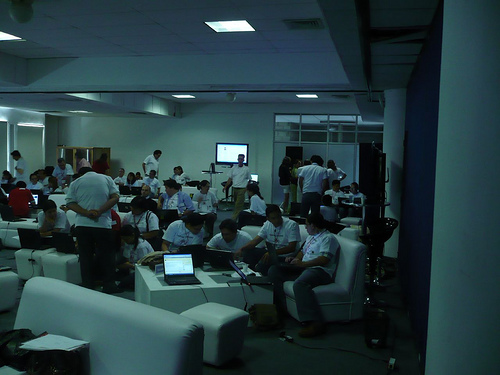
Each of the three sessions I attended were held in a Conference Centre, and as I understood it, this was both to provide a space with a reliable simulatenous internet connection for sometimes over 100 people, but also to find a space large enough for their camp model.

You see, in these educamps, space design was an integral part. The Ministry of Education (and Cintel, their partner in delivering these camps) had gone to the trouble of purchasing very comfortable (and stylish, I might add) furniture that was trucked

around to each event. This might seem like an indulgence until you experienced how this created an informal room setup, allowing learners to sit near each other, easily form small groups, and move around the room, leading to the kind of self-organizing behaviour one expects in a ‘camp’ session.

Similarly, throughout most of the day, there was a soundsystem playing music in the background. This was not simply ‘filler’ though the presence of background music certainly added to the sense of informality and helped people relax. Instead, the music actually became a ‘cue’ to help prompt people in not too directive a way to consider moving along; every so often the volume level of the music would go up, and over time people started to use this as the cue to perhaps look for a new conversation.

There were many other seemingly “small” details which I think had a profoundly positive impact on the experience for these learners. All learners received a white ‘camp’ shirt at the start, creating a bit of an equal playing field. One of the first acitivites was asking the participants to ‘tag’ themselves with which of the classes of tools (they did not focus on single specific tools but instead general classes, like ‘Readers’ or ‘social bookmarking tools’) with which they had experience. In doing this, partly they were making a promise to other learners that if someone came up and asked them about one of their tags, they would talk to them about it.

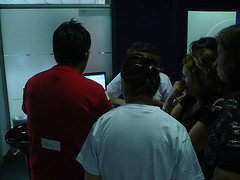
The morning was then given over to the learners exploring (along with some ‘expert’ help, students with some more experience with specific tools, all wearing red shirts) specific tools or groups of tools that they themselves identified as being of interest to them. The idea was not to master the entire array of technologies (there being at least 12 classes of tools that had been identified) nor master them in any prescribed way or order, but instead to explore ones own need in a hands on way, side-by-side with other learners. It is difficult to describe, but I have NEVER seen this kind of buzz or energy happen in ANY of the dozens of North American “pro D” workshops I have led or been subjected to. Indeed, as I told my hosts, I think the great testament to the success of these events is that, despite the fact that they were already scheduled to run from 8am until 5:30pm, we had to kick people out at 5:30!
You can see more photos from the workshop in this flickr collection. They are not great photos, and to some they might look simply like masses of people milling about. To me, they look like masses of people learning together, from each other and not simply mastering prescribed material but actually forming social networks at the same time as they are learning what they wanted and needed to learn. This was a model which truly understood that while studying may be boring, Learning can be fun (and always personal!) A model I hope I can learn to replicate in the years to come. So thank you, Diego, for letting me experience this, it truly was a great learning experience for me. – SWL