Dynamic Wiki-driven OER Search Engine

http://edtechpost.wikispaces.com/OER+Dynamic+Search+Engine

So Stephen pointed to a Google Coop engine that Tony Hirst built out of the OER pointers on ZaidLearn’s OER collection page.

That’s cool, I’m a google coop/constrained search nut, and knowing Tony, he likely finagled some sweet way of automatically getting the links into the Coop engine.

But…why not drive the Coop engine right out of a wiki page? That way, as people find new OER sites, they can easily expand the engine. Sure, Coop itself will let you do this, but you gotta ask permission. This is actually easily accomplished on ANY web page using the “Generate Google Coop Engine on the Fly” javascript code. Ponder that for a second – ANY web page can also become a constrained search engine, simply by inserting a piece of Javascript. Google, I love you. If I were going to have any more kids, I’d name the next one Google. (luckily, I’m not 😉 – SWL

Journal of Online Learning and Teaching Special Issue on Next Generation Learning Systems

http://jolt.merlot.org/vol4no2/abstracts.htm

Maybe I follow the wrong crowd, or maybe it’s just a case of journals becoming increasingly marginal as a way to disseminate work, but I’m surprised, especially given the crowd I do follow, that I hadn’t heard a peep about the latest issue of JOLT dedicated to “Next Generation Learning/Course Management Systems.”

While I found the opening piece quite painful (and a pretty surprising way to lead off an issue on ‘next generation’ systems, if you ask me), if you dig in there is much goodness here. Patricia McGee and Marybeth Green’s piece on “Lifelong Learning and Systems: A Post-Fordist Analysis” is very good, and Gary Brown and Nils Peterson’s article on “The LMS Mirror” is well worth the read, if only for the anecdote of the custodian, something that deserves to be enshrined in ed tech folklore like the story of the perennially shortened roast. And there’s more. Do yourself a favour, have a look, I promise there’s at least one article there you’ll cite in the next year. – SWL

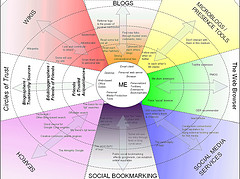
Revised PLE Images Collection & My Own PLE Illustration

http://www.flickr.com/photos/nessman/2590572476/ 

The exercise to collect as many PLE diagrams as I could was not an end in itself, as interesting as that might have been. In doing that, I was hoping to learn from how people conceived of their PLEs and use this as the basis for an attempt to illustrate my own PLE.
Looking at the collection, what struck me was that there were 3 main ways people oriented their PLE diagrams: by tools, by uses, or by people. I added a table of contents to the top of the wiki page that organized the diagrams around these orientations.

There are a few (interesting to me) outliers there as well, ones that combined a number of these orientations into a single diagram. These appealed to me, because I don’t see a PLE, even my own specific one, as being just a single set of tools; we do choose a specific set of tools, but often replace them with others that fulfill a function better. But in addition to the tools and the functions, an important aspect to me is the different ways we can use these tools based on levels of trust/online identity & reputation. That’s why the slogan “PLE is People” isn’t just a joke, funny though it might be.
So with that in mind I set to using my limited drawing skills to visualize my PLE in a way that captured not just the tools, but the uses and the trust relationships as well. I’m hoping the diagram is self explanatory (otherwise, well, what was the point!) but a few explanations:

My PLE Diagram
  • the circles extending outwards from the centre represent different levels of trust/relationships. They are dotted lines on purpose – these are not fixed; relationships change, you get to know some people better etc.
  • the two headed arrows are meant to express the flow of information and learning – it is not all one way. You *can* just read blogs. You *can* just use del.icio.us without using it socially and following others. But I have always maintained that if we view these as actions (‘blogging’ instead of just ‘blogs’) it helps us understand they as conversations, as the “read/write” particpatory web.

Please have a look. Would love to hear some feedback. Does this help illustrate the practice of a PLE any better? This is another one of my diagrams that percolated in the back (and I really do mean the back) of my brain for a while and then last week the specific way to visualize it just popped into my mind. I am not a great artist, indeed, every time I do a diagram like this it reinforces my need to better master a drawing tool (this was done in powerpoint!!!). And while others have ridiculed the term PLE’s in the past as being “just a bunch of drawings” I think that misses the point. A PLE is clearly not just a set of drawings, but the act of producing such a drawing, such a conceptualization, is an incredibly valuable one, not just for any educational technologist but indeed, I’d argue, for any learner, regardless of whether they conceive of it as a “PLE” or not. Knowing how you learn, and how you conceive of the structures and relationships that support your learning, is an important step to becoming a master learner. – SWL

Help choose the future focus of Edutools

The WCET-supported Edutools site has helped people make better informed educational technology decisions since 2001 (and even before that when it was known as “landonline” after its creator, Dr. Bruce Landon).

For the first 4 or 5 years I was responsible for doing most of the product research. This was a wonderful role and helped me understand a number of educational technologies much more deeply. Unfortunately, that model of a central reviewer creating all the content is neither very contemporary in reflecting the importance and abilities of the overall community, nor was it very sustainable.

We have worked up a new community-driven model for an Edutools site that we will be launching in the fall. And as part of the new site, we are going to focus on some new technologies. This is where we could use your help. Help us figure out which educational technologies you would most like to see a new Edutools site focus on by taking the below poll; it’ll only take a few seconds, but will help us focus on things that really matter to you. Thanks! – SWL

[polldaddy|705517]

Learning Sciences and Educational Technology Google Group

http://groups.google.com/group/learning-sciences

Just in case you missed the announcement over on EdTechDev, Doug Holton of Utah State University has put together an announcement service via Google Groups. As Doug notes, many announcements for conference calls for papers or grants in our field happen via email on closed mailing lists, and in an effort to open this up (as well as make the info available via RSS), Doug is reposting them to this group. While it may be of most use to US readers, it is still a valuable public service, so thanks, Doug. – SWL

eduglu singers remix machine

http://www.edtechpost.ca/gems/eduglu_singers_mpc/

When Tony Hirst pointed to this fabulous set of Javascript controls for audio called SoundManager2, I knew I just HAD to try it out. Their fantastic MPC demo is simple to add your own clips to and make your own ‘music’ machine. Now you too can remix the eduglu singers! Have fun! – SWL

Come and get ’em – edupunk merit badges

http://edtechpost.wikispaces.com/edupunk+merit+badges

In the rush and clamour to define “edupunk” (I mean, sheesh, a freakin’ wikipedia article???) I realized what was missing – Merit Badges! What punk doesn’t love some external validation, a way to show off their true inner edupunk, be part of the club.

And so without further ado, we bring you …

(and Jim, hopefully you understand this isn’t aimed at you) – SWL

Collection of PLE Diagrams

http://edtechpost.wikispaces.com/PLE+Diagrams

As part of preparations for a workshop this fall on ‘building your own PLE’ I am collecting diagrams of people’s personal learning environments on this wiki page (or even images illustrating how they conceive of them at a purely conceptual level). I do not want to “boil them down” or reduce them all to the same “thing,” but along the lines of asking what “postures” make up people’s PLEs, I am looking for ways to make a complicated idea/practice more easy to understand for newcomers.

I’m hoping this page will be useful to others. Certainly, I was assisted by a number of people who had aggregated PLE resources, including this extensive wiki. If you feel like adding your own to the list, leave a comment here, or follow the instructions on the wiki page (or just email them to me). – SWL

Understanding e-Learning Technologies-in-Practice Through Philosophies-in-Practice

http://www.aupress.ca/Terry_Anderson/kanuka.pdf

A note that the Second Edition of The Theory and Practice of Online Learning (edited by Terry Anderson) was now available online came through my reader this morning, and not having had the time the first time it came round, I made time to go through a few chapters today.

The one I want to highly recommend to EVERY educational technologist (and educator, for that matter) is the chapter by Heather Kanuka titled “Understanding e-Learning Technologies-in-Practice Through Philosophies-in-Practice.”

Perhaps it is because I am a lapsed philosopher that this appeals to me, but I whole-heartedly agree with the notion put forth here that reflecting on one’s personal philosophies of education and technology is an important activity any of us involved in education and technology should undertake (along the lines of the ‘unexamined life not being worth living.’)

Kanuka lays out 3 general philosophies of technology (“uses determinism,” “technological determinism,” and “social determinism”) as well as 5 philosophies of education (“Liberal/Perennial,” “Progressive,” “Behaviourist,” “Humanist,”  and “Radical”) for us to consider.  It is entirely possible that none of these feel like a perfect fit for you, but they provide a good overview starting point to consider your own orientation(s).

Gotta run, but I’ll just end of a slightly facetious note that the conclusion of the paper (“Unless we can systematically identify what we value in education, we cannot justify the choices we make with e-learning technologies, or deliver the promises“) is in itself a philosophical position. While not one I necessarily disagree with, it would be easy to deconstruct the entire piece through that lens of the agency it presupposes. I too make that supposition, regularly, but contingently, always entering back into a dance with these other positions (or, in riposte to Aristotle, “the continually re-examined life is even more worth living”) – SWL

Making the case for “Fully Open” Content

I’ve asked twitterites a few times but haven’t got much of a reply yet, so I’m hoping readers have a reference or two to throw my way. Here’s the question – I work on a project that helps share educational resources. We currently support two licenses, a Creative Commons license and a regional consortia license called the “BC Commons” which facilitates sharing amongst the public post-secondary institutions in BC. Obviously this latter is not a “fully open” license as it does limit who can see and reuse the content. We’ve always seen it, I think, as an interim step, a way to get people into the habit of sharing their content but in a ‘safe’ way (and a way that the funders, the BC government and taxpayers, could be convinced of the immediate benefits).

Increasingly we are looking to try and increase the use of “fully open” licenses like Creative Commons, but in order to take this step we need to make the case to funders (as well, ultimately, to the content owners) as to why publishing under a fully open license is a better idea, for them, for the funders and ultimately the taxpayers.

So, I am looking for as many good references as I can find to help make the case. I wish it were enough to simply point people at David Wiley’s BCNet talk from 2007 [audio here | video here] (heck, it was given here in BC) because if you ask me, slam dunk!

Unfortunately, I need more, especially actual studies of the benefits or effects of sharing in a fully open way (and especially where a group moved from a more closed to more open model of sharing). Anything that can support or illustrate these kinds of arguments:

  • making resources fully open increases the number of accesses (and reuse) of resources, both within and outside of the original constituency
  • resources that are made fully open will have more improvements made to them, and thus end up as higher quality resources at no cost, then resources that aren’t
  • making resources fully open can provide additional returns for the organizations that do so in the form of increased brand recognition, increased student enrollments, better prepared existing students, etc.
  • making resources fully open leads to increased opportunities for partnership
  • making resources fully open does not substantially impact revenues to the content owner or institution (and indeed may increase it)

Anything is helpful, and I assume there are others trying to make this case in their own jurisdictions. Do you know of any studies that we can cite to substantiate the above propositions? Or indeed other propositions we should be staking the case on? –SWL