
Guide to Institutional Repository Software

http://www.soros.org/openaccess/software/

Really helpful report from George Soros’ Open Society Institute that looks at the currently available open source institutional repository systems that comply with the Open Archives Initiative metadata harvesting protocols. (Note these aren’t ‘learning object’ repositories per se – these are typically more focused on archiving scholarly publishing and other institutional materials, though through things like z39.50 and the IMS digital repositories interoperability spec it may end up that your searches go against these repositories and more.)

You’ll have seen this already over at OLDaily (you do read Stephen already, don’t you?) – this post was more a personal note as this was one of those ‘just in time’ nuggets that float through the blogosphere and land on your desktop seconds before you knew you needed them. Hurray!. – SWL
Wiki for project work at Wesleyan University

http://twiki.wesleyan.edu/cgi-bin/view/Projects/WebChanges

The actual front page for the entire Wesleyan Wiki is at http://twiki.wesleyan.edu/cgi-bin/view/Main/WebHome but the page above points to recent changes on various project-focused wiki pages and shows a vibrant little site. Just pointing it out as another living breathing example of wikis being used to collaborate and coordinate within an organization – in this case they’re using Twiki. – SWL

B.C. Educational Technology Users Group ‘Blogtalk’

http://etugblog.typepad.com/blogtalk/

Today is officially the last day so I can finally let the cat out of the bag for those who haven’t seen this yet.

As I mentioned in an earlier post, for the past two weeks I’ve been helping to facilitate, along with 4 other educators from B.C., an ‘online discussion’ on possible uses of blogs in education for the B.C. Educational Technology Users Group (ETUG). Many of you will recognize at least one of the other facilitators, Brian Lamb from UBC…
Continue reading “B.C. Educational Technology Users Group ‘Blogtalk’”

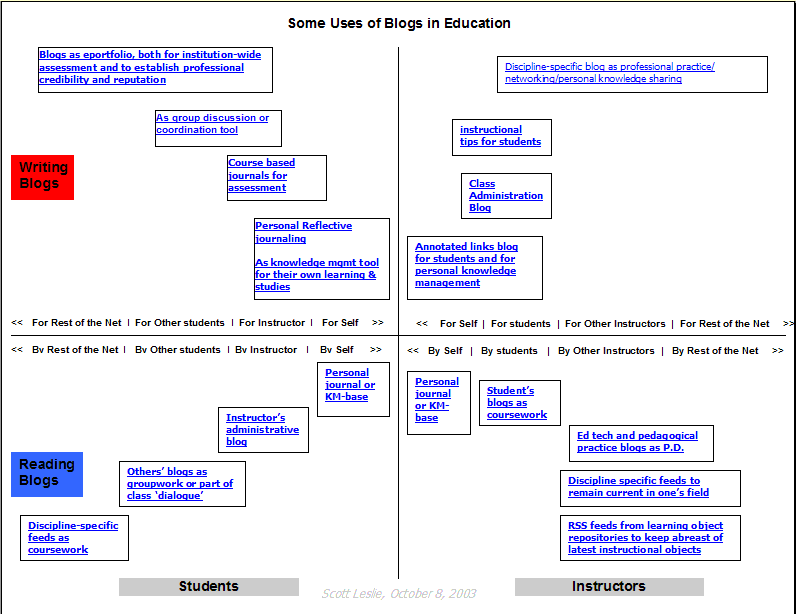
Matrix of some uses of blogs in education

This week and next I’m helping to facilitate an online discussion on the use of blogs in education for about 400 members from the B.C.-wide Educational Technology Users Group.

We are facilitating the discussion through a multi-author Typepad blog (there are 4 other facilitators involved). We’ve structured the sessions to begin with an introduction to what blogs are and how to read and write them. We’re now moving into Day 4 and from hereon we get into far more interesting stuff – what are the actual applications of blogs in education. It is a very diverse group of participants ranging widely across job descriptions, disciplines and skill sets.

To help facilitate this discussion and my own thinking on it, I’ve worked up this matrix of some of the possible uses of blogs in education.
Continue reading “Matrix of some uses of blogs in education”

Elearning Research Questions from Mark Oehlert

http://www.teleworks.com/blog/
markoehlert/archives/000094.html

Mark Oehlert has posted an interesting set of survey questions as a word doc on his site, which he is asking people working in the ‘elearning’ filed to answer. It includes such thought provokers as:

  • 9. Do you see a convergence or divergence between the worlds of corporate training and higher education in the realm of e-learning?
  • 10. Are you aware of any groups or skill sets not currently represented as fully as they should be in the e-learning mix (e.g. anthropologist)? Have you ever seen a company attempt to also sell the ability to shift corporate culture to maximize an investment in e-learning along with the product?
  • 14. Can a cell phone be a learning device?

Mark is involved in some fairly large ‘games’ and so if you want to have an impact here’s one chance to make your voice heard. – SWL

The recombinant library: portals and people

http://www.oclc.org/research/staff/dempsey/
dempsey_recombinant_library.pdf

I love papers on portals that begin by thoroughly trashing the word ‘portal,’ as my experience has been that it is one of the most unuseful pieces of modern tech jargon.

But this paper takes the conflation of the meanings of the word portal as its starting point and explores it to rich effect. Although it’s written by and for librarians, one of the reason the paper’s so effective is in arguing that approaching portals from the library’s perspective is precisely the wrong end to come at it; you need to approach it from the user’s perspective. Well worth reading for anyone involved in campus-wide portal initiatives. – SWL

– via [ResourceShelf]